
I’d been bagging groceries and washing dishes since I was fifteen, sneaking every dollar into an old box under my bed. Three thousand dollars. My future in crumpled bills and worn-out envelopes.
“We used it,” my dad said. “Applications, fees, all the stuff your brother needs for his next step. You earned that while living here. Consider it paying us back.”
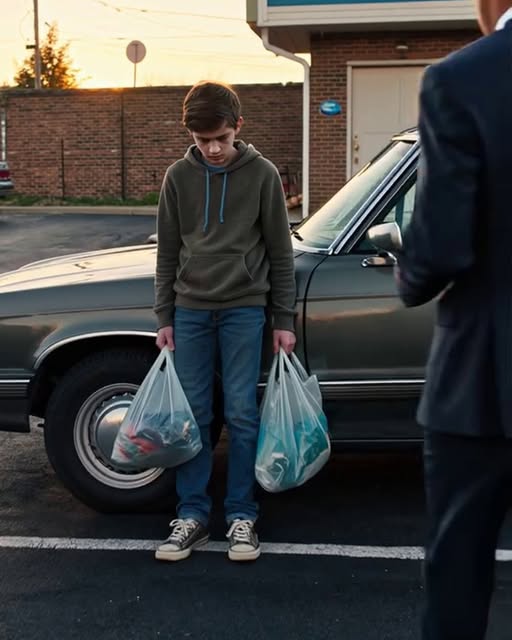
They kept his college dreams. They handed me three plastic bags and the driveway.
I picked up those bags, walked to my old car parked at the curb, and told myself not to cry until I closed the door.
I lasted about ten seconds.
That night I slept in the backseat of a fifteen-year-old sedan in a random parking lot, hugging my hoodie like it could fix anything. The heater barely worked, but the silence did. At least out there, no one looked at me like I was in the way.
For nine days, that car was my bedroom, my closet, my whole world.
I still went to school. I still raised my hand in class, took notes, joked with friends in the hallway like nothing had changed. I showered in the locker room before sunrise and hoped nobody would notice how often I wore the same jeans.
After the final bell, I’d drive around until I found a place I thought was safe enough to park. A big-box store lot. A quiet side street. A spot behind a strip mall where nobody asked questions as long as you didn’t make trouble.
Hunger felt different when you knew there wasn’t a real dinner waiting somewhere. Lunch at school became the one thing I could count on. I’d eat half and save half for later, pretending I wasn’t watching every bite.
By day nine, the gas tank was empty and so was I.
My car died behind a row of restaurants, wedged between delivery trucks and dumpsters that smelled like everything I couldn’t afford. I sat there for a long time, forehead against the steering wheel, listening to cars on the main road and trying not to freak out.
Eventually, hunger won.
I slipped around back, hoping someone had tossed out bread that wasn’t too old, or a box of something they couldn’t sell. I wasn’t proud of it. I was just tired of pretending I wasn’t starving.
That’s when I heard my name.
“Excuse me. Are you Nathan Brooks?”
I froze.
When you’re sleeping in your car and trying not to be noticed, your first instinct is always to run. I spun around anyway.
He didn’t look like a social worker or a cop or someone who wanted a problem. He looked like he’d walked out of a different kind of life entirely. Dark suit, polished shoes, tie straight, hair perfect. The kind of person who has important places to be and doesn’t usually show up behind a restaurant.
“Who’s asking?” I said.
He pulled a small card from his pocket and held it out like we were meeting at an office on a normal Tuesday.
“My name is Richard Hartwell,” he said. “I’ve been trying to find you.”
Nobody had ever said that to me in my life.
I didn’t take the card. I just stared.
“I represent the estate of James Brooks,” he went on. “Your grandfather.”
I almost laughed. “I don’t have a grandfather. He died before I was born.”
He looked at me for a moment, and I saw something shift in his face. Not pity, exactly. More like the look a doctor has right before they explain something you won’t want to hear.
“That’s not true, Nathan,” he said quietly. “Your grandfather passed away a few weeks ago. He left instructions for us to locate you as soon as possible.”
I opened my mouth, then closed it again. The parking lot spun a little.
“Why?” I managed.
Richard glanced at my car, at the trash cans, at my clothes that had seen better days. He lowered his voice like we were suddenly in on the same secret.
“Because,” he said, “he left his entire estate to you. The house, the business, the accounts. Everything.”
My brain couldn’t catch up. Ten minutes earlier, I’d been trying to work up the nerve to see if there was anything edible left behind a building. Now a stranger in a suit was telling me I owned more than I’d ever seen in my life.
He looked me right in the eye.
“But there’s one condition,” he said. “And it changes everything.”
My dad told me to leave on my eighteenth birthday and the stranger in a suit who found me behind a restaurant one week later
Pages: 1 2
